Best Bowling Ball for Beginners: How to Choose Your First Ball (2026)
Finding the best bowling ball for beginners starts with fit. A house ball is drilled to serve many different hands, so it rarely matches one bowler as closely as a ball fitted and drilled for that individual. Poor fit can encourage squeezing, make the release harder to repeat, and make it more difficult to separate technique problems from equipment problems.
A properly fitted personal ball gives you the same grip and span from session to session. That consistency does not make the release automatic, but it removes one variable while you learn timing, direction, and release mechanics.
The next question is what type of ball to buy. Polyester is predictable and straight but offers very little hook. Strong reactive equipment can create more traction and shape than a new bowler needs while still learning basic timing and control. If you want a broader overview before narrowing your choice, our bowling balls hub is a useful starting point. The picks below are based on manufacturer specifications, published technical guidance, USBC equipment information and rules, and verified long-term owner and community feedback. Where we have relevant first-hand experience, we label it separately.
Below, we explain what each ball does and who should buy it.
Updated: 2026 · Edited by Jeroen Kooij · See methodology below
Storm Tropical Surge Pearl
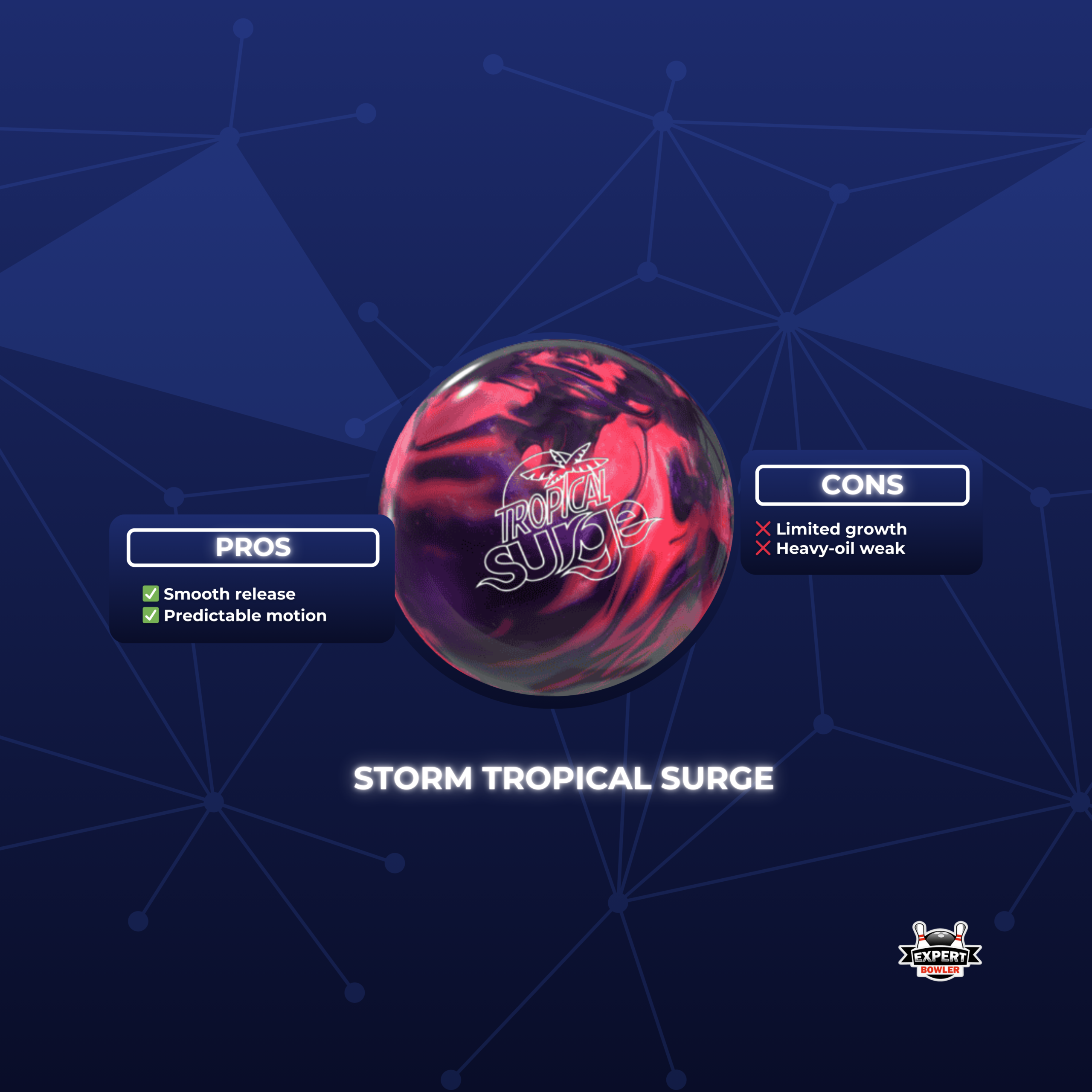
The Storm Tropical Surge Pearl provides the forgiveness new bowlers need at a price that won’t break your budget. It features a Surge Core (2.57 RG, .025…
Check price →Storm Hy Road
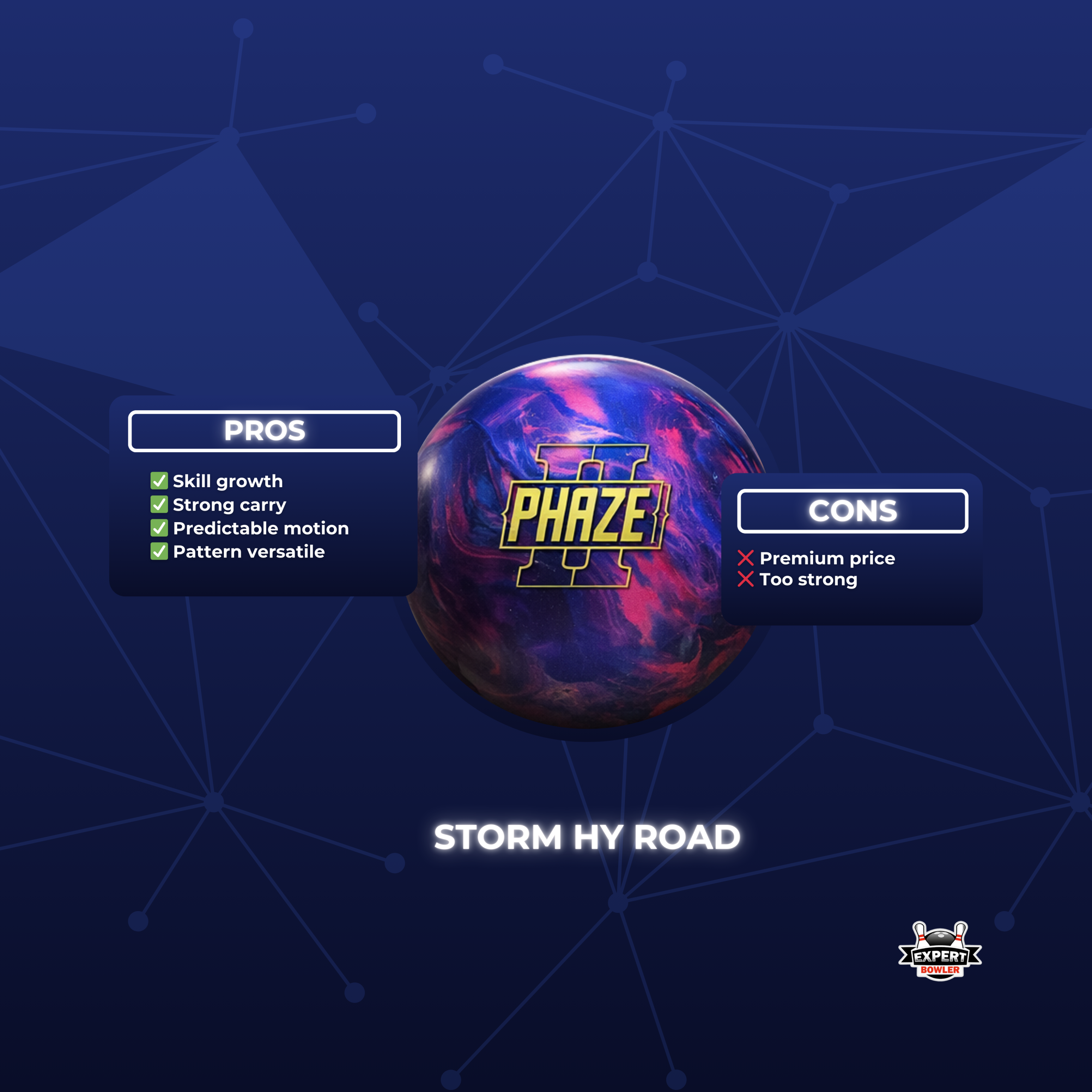
The Storm Hy-Road gives a committed beginner more room to grow than many entry-level reactive balls. Its stronger overall motion makes it better suited to…
Check price →Roto Grip Hustle M+M
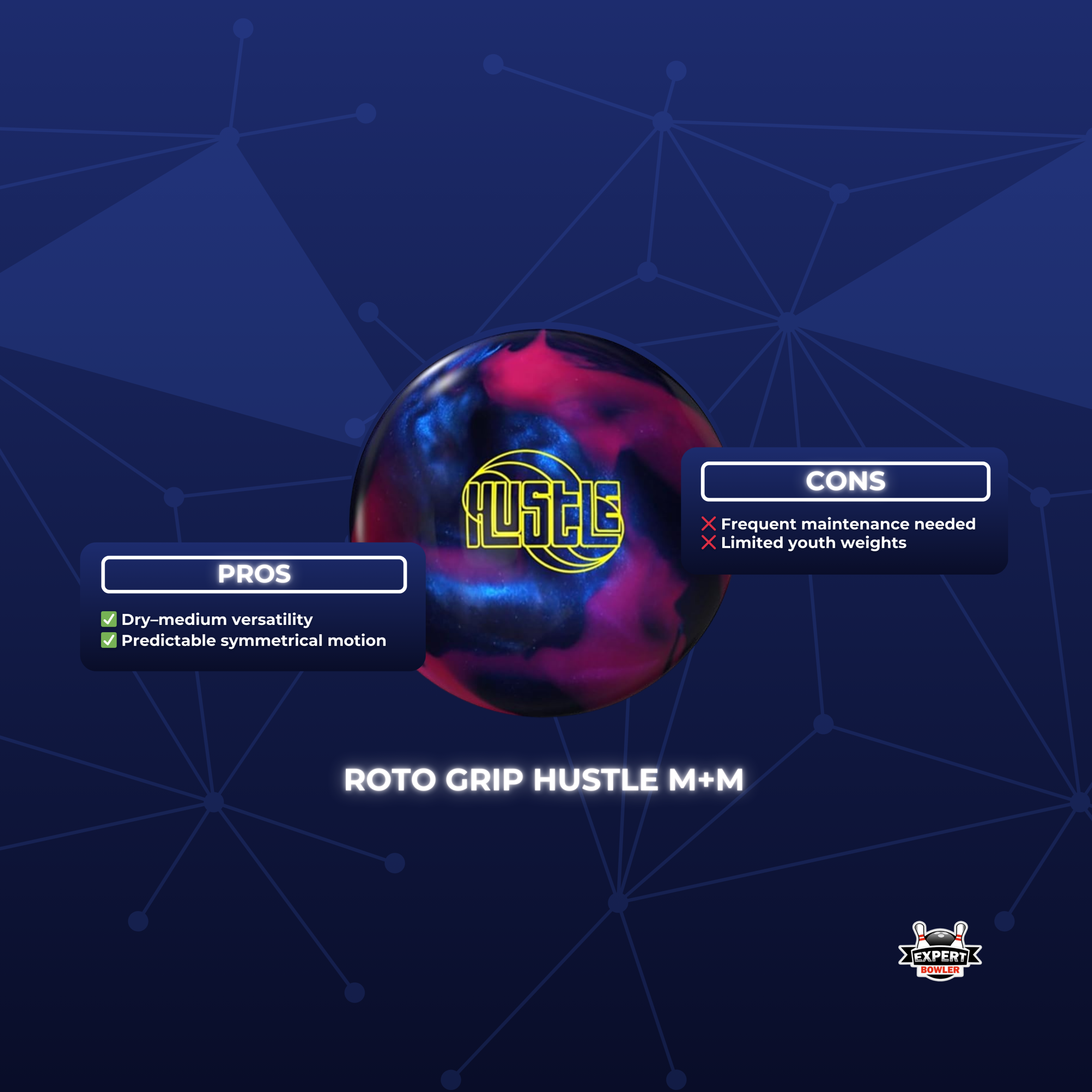
The Roto Grip Hustle M+M offers the best balance of performance and price among beginner options — a Storm-family ball with a symmetric core and VTC pearl cover.
Check price →Quick picks at a glance
How we evaluated
Our picks come from a structured editorial process — not from pretending we personally tested every ball. We compare each option against the same beginner-focused criteria and separate sourced conclusions from our own first-hand experience.
Beginner-fit criteria
We define what matters for a first ball before ranking anything: controllable motion, lane-condition fit, available weights, price, and enough performance to remain useful as technique develops.
Manufacturer specifications
Core numbers, coverstock type, factory finish, weight availability, and intended lane conditions are checked against official product documentation.
Published & owner evidence
We cross-reference established technical sources with long-term owner reports and verified community feedback, looking for recurring patterns rather than isolated comments.
First-hand context
Anything we have actually done ourselves — such as being fitted, having balls drilled, or learning through recorded coaching sessions — is labelled as first-hand and does not get presented as universal proof.
We do not claim hands-on testing of a ball unless we have actually used that ball. Most product conclusions on this page come from specifications, published sources, and verified owner/community evidence. Our own beginner experience is clearly separated where it is relevant.
Paid placements, sponsored rankings, or manufacturer-supplied review samples that come with editorial expectations.
Answer four quick questions and our free Bowling Ball Finder matches you to the right ball for your style, lanes and budget — plus a free buyer’s checklist, instantly.
Take the free Finder →Storm Hy Road
The Storm Hy-Road is the most performance-oriented option in this beginner list. Its reactive cover and benchmark-style shape give a developing bowler more room to learn ball motion than polyester, while still being more controllable than many stronger asymmetric options.
The Hy-Road uses an Inverted Fe² core and R2S Hybrid coverstock. The polished hybrid cover is designed to retain length through the front part of the lane before responding to friction farther downlane.
You’re not fighting a ball that hooks too early while you’re still learning to release it properly.
Bowlers moving from house balls often value the Hy-Road for its smooth, readable shape. It is versatile enough to remain useful across a range of typical house-shot conditions, although no single ball covers every lane condition or every stage of a bowler’s development.
This ball is a bit pricey. $140, it sits at the top of the beginner price range, and its higher hook potential can overwhelm bowlers still working on consistent speed and rev rate.
If you are a committed beginner who wants a first reactive ball with more long-term versatility than a pure entry-level option, it is a strong choice.
For the full specification read, lane-condition fit, and watch-outs, see our Storm Hy-Road review.
View Storm Hy Road on Amazon →Storm Tropical Surge Pearl
The Storm Tropical Surge Pearl provides the forgiveness new bowlers need at a price that won’t break your budget. It features a Surge Core (2.57 RG, .025 differential) and a Reactor Pearl coverstock, a combination that smooths out release inconsistencies and creates gentle, readable ball motion.
When your hand position varies shot to shot (and it will as a beginner), this ball doesn’t punish you with wild reactions.
It’s a great choice for new bowlers looking to gain confidence because the Tropical Surge reacts predictably. It offers enough hook to teach proper release mechanics without snapping aggressively through the pins.
The pearl finish glides through the front part of the lane, giving you time to read the ball’s path. For early league games or practice sessions, this consistency allows you to focus on footwork and timing rather than fighting your equipment.
Its main limitation is ceiling rather than usability: as speed, rev rate, and lane-reading skill develop, some bowlers eventually want a stronger or more specialized reaction. That does not make the Tropical Surge obsolete; it can still remain useful on drier conditions or when a smoother response is desirable.
For the full specification read, lane-condition fit, and limitations, see our Storm Tropical Surge review.
View Storm Tropical Surge Pearl on Amazon →Roto Grip Hustle M+M
The Roto Grip Hustle M+M offers the best balance of performance and price among beginner options. Roto Grip (a Storm brand) built with a Hustle symmetrical core (2.54 RG, .030 differential) and a VTC Pearl Reactive coverstock, it reads the midlane smoothly while still providing enough backend motion to teach proper hook technique—all for around $109.
For beginners, the Hustle M+M offers room to grow without needing new equipment every few months. It handles both dry and medium oil conditions, the two patterns you’ll encounter most at league bowling.
Like any reactive coverstock, the VTC Pearl benefits from regular surface care. Wipe lane oil from the ball during play and clean it after sessions with a bowling-ball-safe cleaner; maintenance frequency should follow use and reaction change rather than a fixed calendar rule.
It’s not available below 10 lbs, so younger children need another option.
Its appeal is value: it offers genuine reactive-ball motion and room to develop without moving straight into a higher-priced benchmark option.
The symmetrical core helps keep the overall response readable while you work on repeatability. Any improvement in scoring will depend far more on fit, spare conversion, accuracy, lane play, and practice quality than on the ball alone.
View Roto Grip Hustle M+M on Amazon →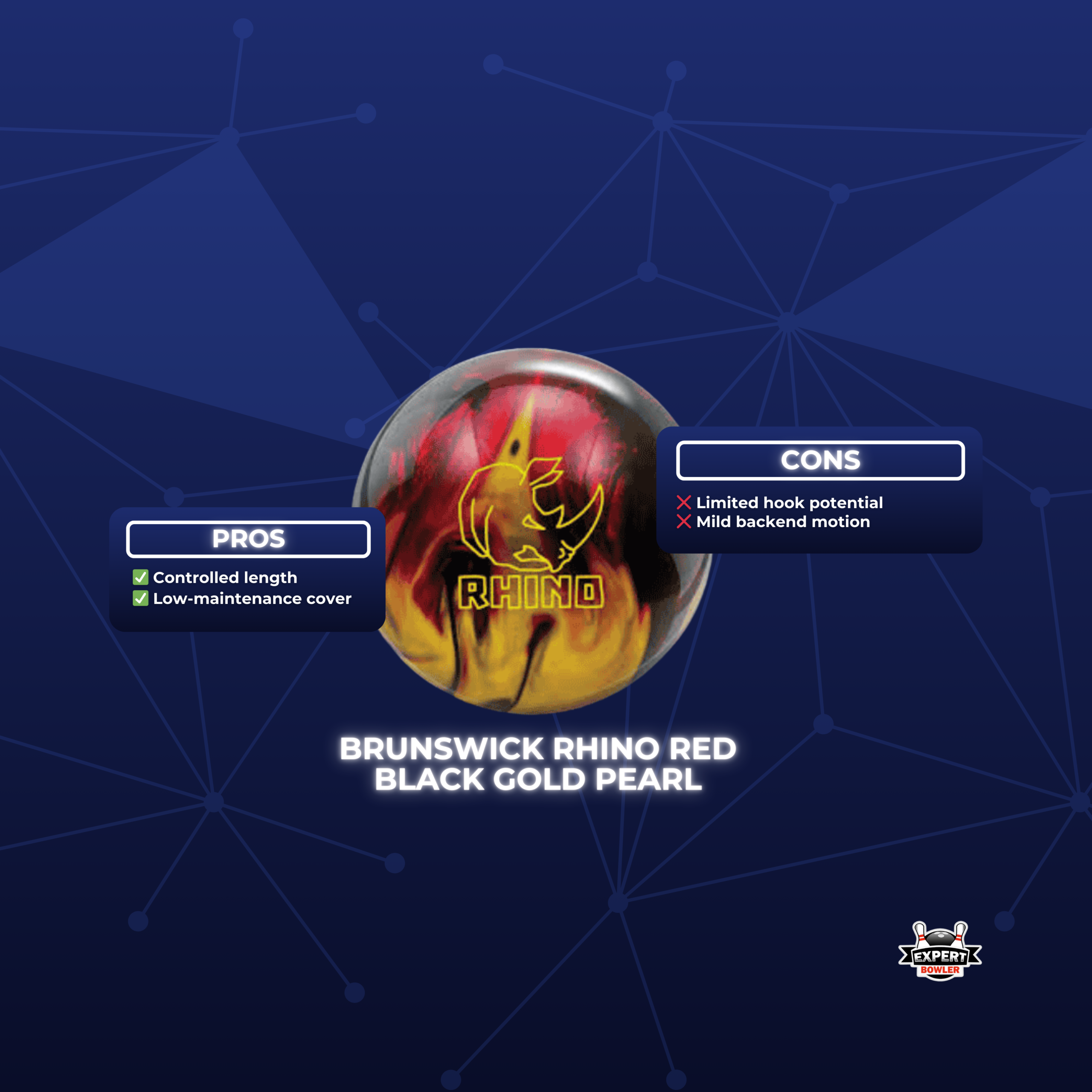
Brunswick Rhino Red Black Gold Pearl
Brunswick equips this ball with a Light Bulb core (2.52 RG, .030 differential) and an R-16 reactive pearl coverstock. The low differential reduces overall hook, keeping shots manageable while you develop fundamentals, but still revealing more reaction as your technique improves.
The Rhino’s lower-flare, smoother reaction is easier to read than stronger equipment, which can make release differences less dramatic for a developing bowler. It is best suited to typical house-shot and lighter-oil conditions.
As release consistency and rev rate develop, the Rhino gives enough visible reaction to show how changes in speed, hand position, and lane friction affect the shot. For bowlers testing their commitment to the sport, it offers a relatively low-cost route into a fitted reactive ball.
Its limitation is heavy oil. On sport patterns or freshly oiled lanes, the Rhino may not gain enough traction to reach the pocket consistently. It’s a house-shot specialist ideal for recreational and early league bowlers, but limiting if you move toward competitive play.
If you want a closer look at how it rolls and What Makes the Brunswick Rhino a Top Choice for New Bowlers?
For an in-depth look, read our full Brunswick Rhino Red Black Gold Pearl review.
View Brunswick Rhino Red Black Gold Pearl on Amazon →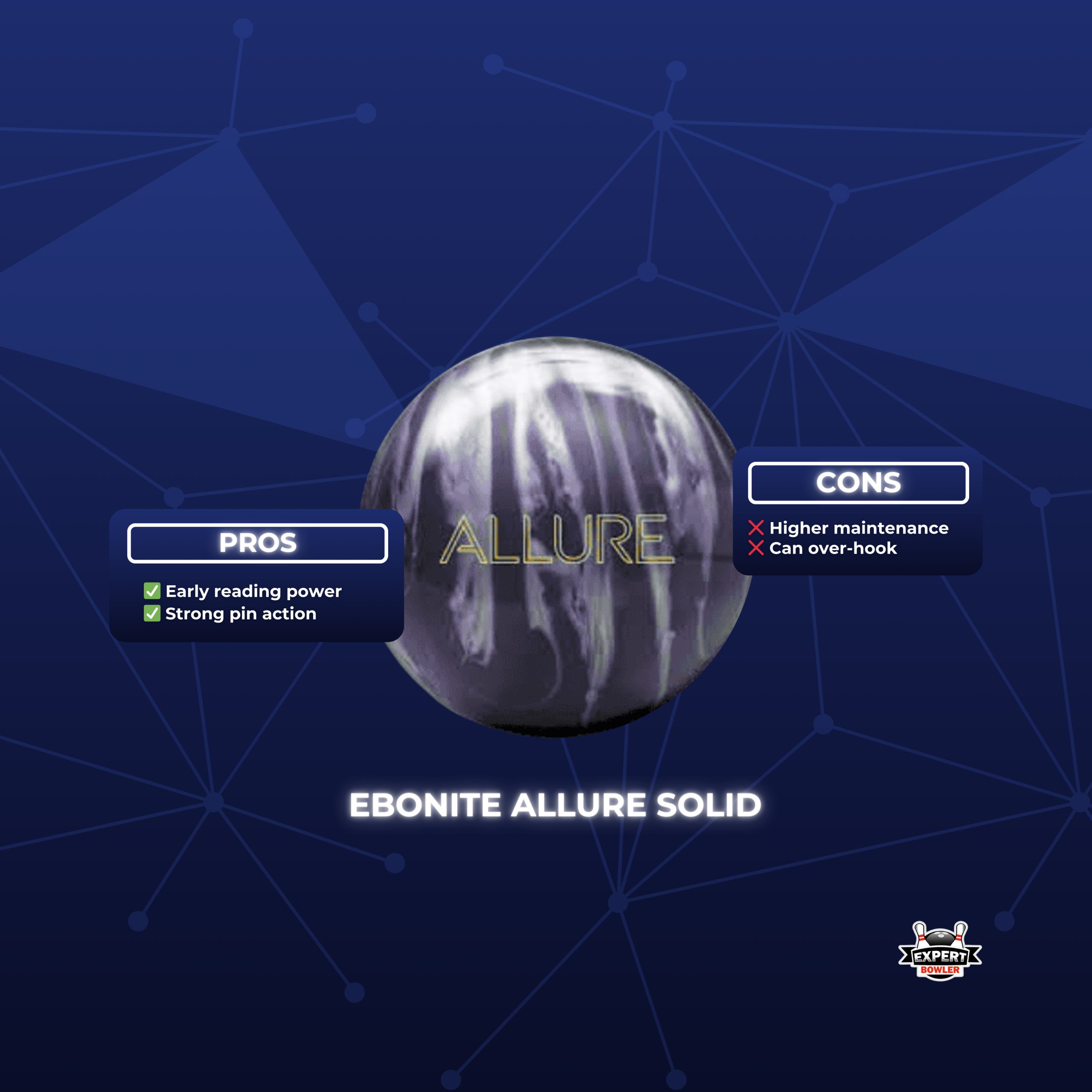
Ebonite Allure Solid
The Ebonite Allure Solid stands out with its solid reactive coverstock; most beginner balls use pearl finishes.
It’s GB 12.0 solid cover grips earlier and creates more overall hook, making it ideal for bowlers focused on developing their hook shot. The two-piece core (2.7 RG, .049 differential) keeps motion predictable despite the added friction.
For athletic beginners or bowlers with naturally strong hands, the Allure provides enough hook to stay engaging without being uncontrollable. It clearly shows differences between good and poor releases, helping you understand ball motion and lane conditions early on.
Its earlier read can make changes in friction more visible than a very weak pearl ball, which may help a developing bowler learn how surface and oil affect ball motion. It is better viewed as a more demanding learning tool than as a shortcut to developing a hook.
Beginners with inconsistent speed or direction may find the stronger, earlier response harder to control than the weaker pearl options above. Its surface also benefits from closer maintenance attention if you want to preserve the intended reaction.
We recommend it for beginners who already have enough control to benefit from a stronger read of the lane, rather than as the simplest possible first ball for an absolute newcomer.
View Ebonite Allure Solid on Amazon →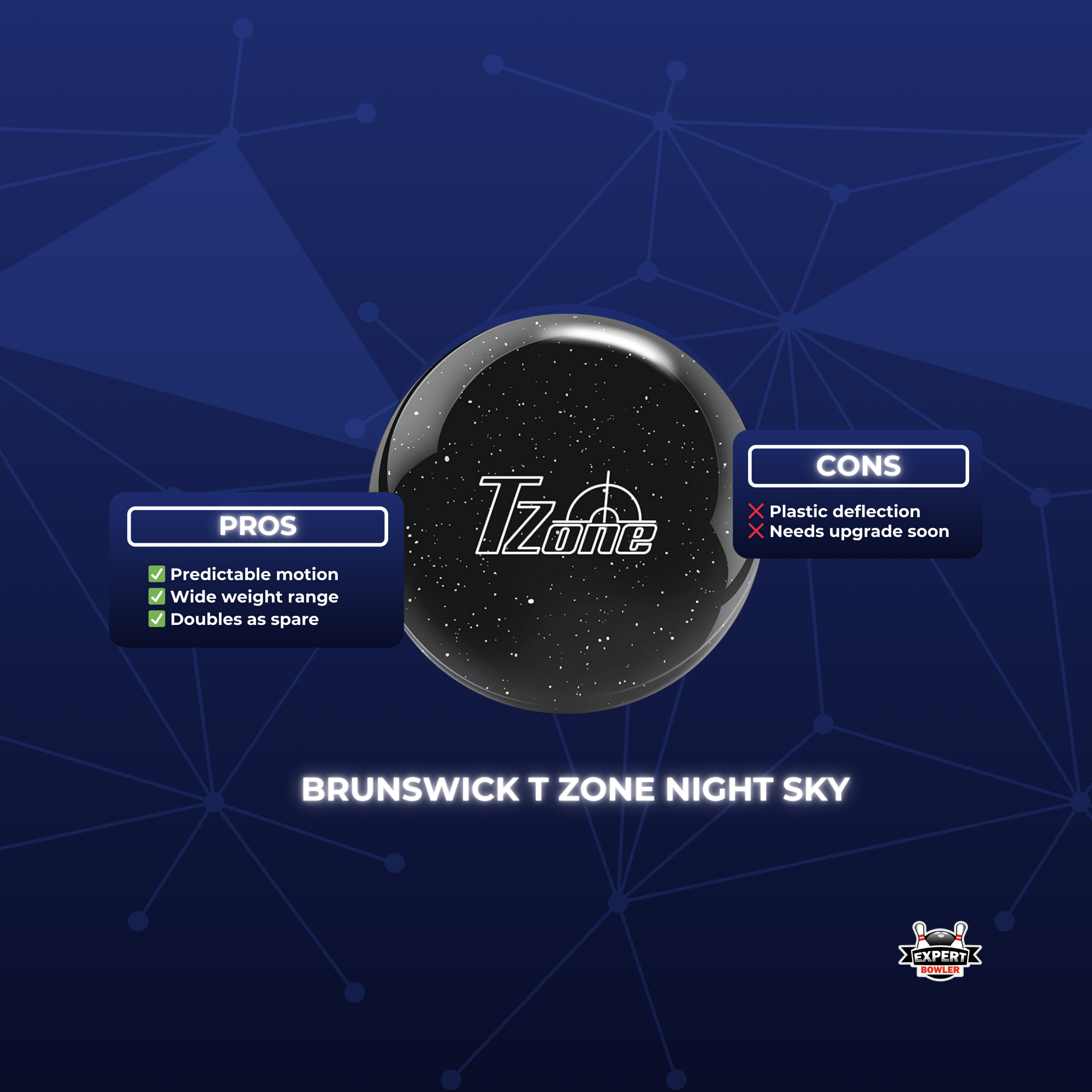
Brunswick T Zone Night Sky
The Brunswick T-Zone uses a traditional polyester (plastic) coverstock, producing minimal hook and maximum control. At $65, it costs less than half of most reactive balls. The Bullet core (2.72 RG) promotes a true end-over-end roll, ideal for spare shooting or bowlers who prefer a straight ball.
For absolute beginners, the T-Zone removes variables from the learning process. The ball goes where you aim without curving unexpectedly. This direct feedback helps develop alignment, timing, and release consistency skills that matter regardless of future equipment.
Parents buying for kids benefit from the wide weight range (6–16 lbs) and low replacement cost if interest fades.
The major limitation is its lack of hook. If your goal is to learn reactive-ball motion, you will eventually need a reactive option. The T-Zone makes more sense as a straight-control or spare ball that can also serve for early practice than as a long-term strike ball for someone who wants to develop hook.
To see how the Brunswick TZone rolls, what makes it a strong spare option, and whether it fits your game, check the full Brunswick TZone review.
If you bowl often enough that you want to work on repeatability, a personal ball fitted to your hand can remove the fit changes that come with switching between house balls. Poor fit can encourage squeezing or discomfort, so comfort and control matter more than following a fixed frequency rule for when to buy.
Choosing between polyester and reactive resin changes what you can learn from the ball motion. Polyester stays straighter and simplifies directional control and spare shooting; reactive resin creates more friction and hook potential, which makes it more useful for learning how release and lane conditions shape ball motion.
For an in-depth look, read our full Brunswick T Zone Night Sky review.
View Brunswick T Zone Night Sky on Amazon →Before you have it drilled: the thumb-hole question
Every ball on this page is a sound first ball. What no specification sheet tells you is that how it gets drilled can decide whether you are allowed to use it in a league — and that matters if you are being taught to bowl two-handed, which a growing number of beginners now are.
We ran into this ourselves, and in a way that turned out to be more useful than tidy. We started lessons with a coach in July 2026 and are being taught the two-handed style from the first session — and of our two balls, one is drilled for it and the other still carries the conventional thumb hole that nobody now puts a thumb in. Both are fine to practise with, and we bowl with both. Only one of them is fine for sanctioned play. USBC has classified an unused thumb hole as a balance hole since 1 August 2014, and balance holes have been prohibited in USBC competition since 1 August 2020. Put those two rules end to end and a two-handed bowler with an unused thumb hole is holding a ball that is not legal for league or tournament play until the hole is plugged. The Dutch federation applies the same standard from the 2020–2021 season: a maximum of five gripping holes, you must be able to demonstrate that you use each one, and any hole you do not use counts as a balance hole.
There is a second detail almost nobody mentions. A ball drilled without a thumb hole has to carry an engraved cross at the centre of the palm, which the bowler covers with the palm during the delivery. If a thumb hole is plugged later, that cross has to be added too — it is part of the same job.
None of this changes which ball you should buy, and it does not mean you have to know yet which style is yours. As a genuine beginner you can go either way, thumb or no thumb, and find out which one your hand actually prefers — that is exactly how our own coaching runs: a short list of principles, and past those, whatever works for you. What it changes is one conversation: tell your pro shop on the day you order which of the two you are going to try first. Having it drilled that way from the start costs nothing extra. Plugging and re-drilling later does.
Frequently asked questions
Get our honest 2-page checklist — coverstock, weight, lane oil, and the 5 mistakes that cost most bowlers money. One short email every couple of weeks. No spam.
Edited by Jeroen Kooij
Publisher & Editorial Director · Beginner Bowler
Jeroen sets ExpertBowler’s editorial standards and documents his own beginner development through recorded coaching sessions with NOC*NSF Master Coach Jack Edelaar. That first-hand experience is kept separate from product research and only used where it adds relevant context. Read how we research, test, and update our content.
Methodology: Picks evaluated against manufacturer specifications, USBC equipment information and rules, published technical sources, and verified long-term owner/community reports. First-hand experience is labelled separately. We do not accept paid placements.
Updated: August 2026.
Sources consulted
- Manufacturer documentation: official product specifications, coverstock/core data, weight availability, and intended lane-condition guidance
- USBC equipment & rules: equipment specifications and the rules relevant to gripping holes and sanctioned competition
- Published technical sources: established bowling references used to cross-check ball motion, fit, and beginner-equipment guidance
- Community & owner feedback: verified long-term reports and recurring themes from bowling forums and owner reviews
- First-hand experience: our own pro-shop fitting, drilling experience, and recorded coaching sessions are used only where explicitly labelled in the article