Hammer Spawn Review 2026
Hammer’s spring lineup added a strong solid in the Spawn, and it shows up wearing a cover a lot of serious bowlers already know. The shell is the HK22C² Solid, the same reactive that sits on the Zero Mercy Solid, this time run coarse and dyed black. Underneath is the Gauntlet, an asymmetric core Hammer first put in play back in 2017 and pulled out of the vault for this release.
The idea is straightforward: most strong solids read great on fresh oil, then turn into a handful the moment the pattern breaks down. Hammer built the Spawn to push back on that — a heavy-oil ball you can stay with longer instead of parking it after game one. Whether it clears that bar, and whether it does enough to justify a spot over proven favourites like the Black Widow 3.0 or Zero Mercy Solid, is what this review works through.
Updated: July 2026 · Reviewed by Jeroen Kooij · See methodology below
Hammer Spawn Review
A controllable heavy-oil asymmetric: a strong, repeatable shape for oilier nights, for bowlers who already have the rest of the bag handled.
Check today's price on Amazon →Prices shift week to week — this opens the live Amazon listing.
Read this before clicking buy
- It ships undrilled. Budget a one-time pro-shop fee of roughly $20–50 for drilling.
- Bring your hand to the shop for span, rev-rate and speed measurements before drilling — a mismatched fit cannot be returned.
- It is a heavy-oil ball, not a dry-lane fix. On dry or burned house shots the coarse cover burns up early.
- This is an arsenal piece, not a first ball. A strong asymmetric wants revs, speed and real oil volume to look its best.
Hammer Spawn Specs at a Glance
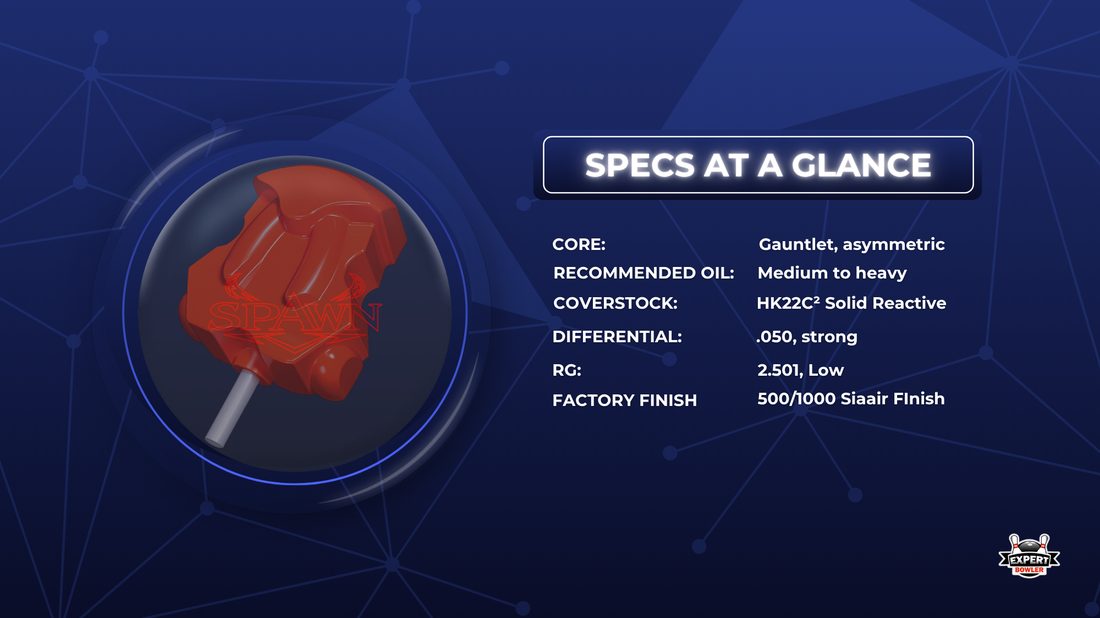
The Spawn already sits on the USBC approved ball list, so it is legal for sanctioned league and tournament play as it ships.
The Technology Behind the Spawn
The Gauntlet Core
The Spawn’s Gauntlet is an asymmetric shape Hammer first ran on 2017 equipment and brought back for this release. At 15 pounds it lists a 2.501 RG, low enough to start the ball revving before it reaches the arrows, paired with a .050 differential that drives strong flare.
The .012 intermediate differential is mild for an asymmetric, which is why the shape reads rounded and drivable rather than a nervous, snappy flip.
What is an asymmetric core?
An asymmetric core is a weight block shaped so its three axes each rev up differently, building in a preferred roll and a touch of extra imbalance. That raises flare potential and sharpens the ball’s move where it meets friction. Drillers reach for asymmetric cores when a bowler wants more shape and a firmer, more defined breakpoint on oil.
The HK22C² Solid Cover
The HK22C² Solid already has league mileage under the Zero Mercy Solid, so how it drinks oil and how it wears is less of an unknown than a brand-new shell would be. A solid reactive like this carries more open pores than a pearl, so it reads the midlane and grabs friction earlier instead of coasting over it — exactly what you want out of a heavy-oil piece.
Not sure whether a solid is the right choice? Our guide to solid, pearl, and hybrid coverstocks breaks down when each type performs best.
The 500/1000 Siaair Box Finish
Hammer ships the Spawn at a coarse 500/1000 Siaair with nothing polished over it, on purpose. That rough grit holds the front and mids instead of skating, so the ball starts working sooner than a shinier piece would. It also means the box finish is likely too aggressive for many typical house shots unless there is enough oil to support it.
On-Lane Read: Midlane, Breakpoint, and Backend
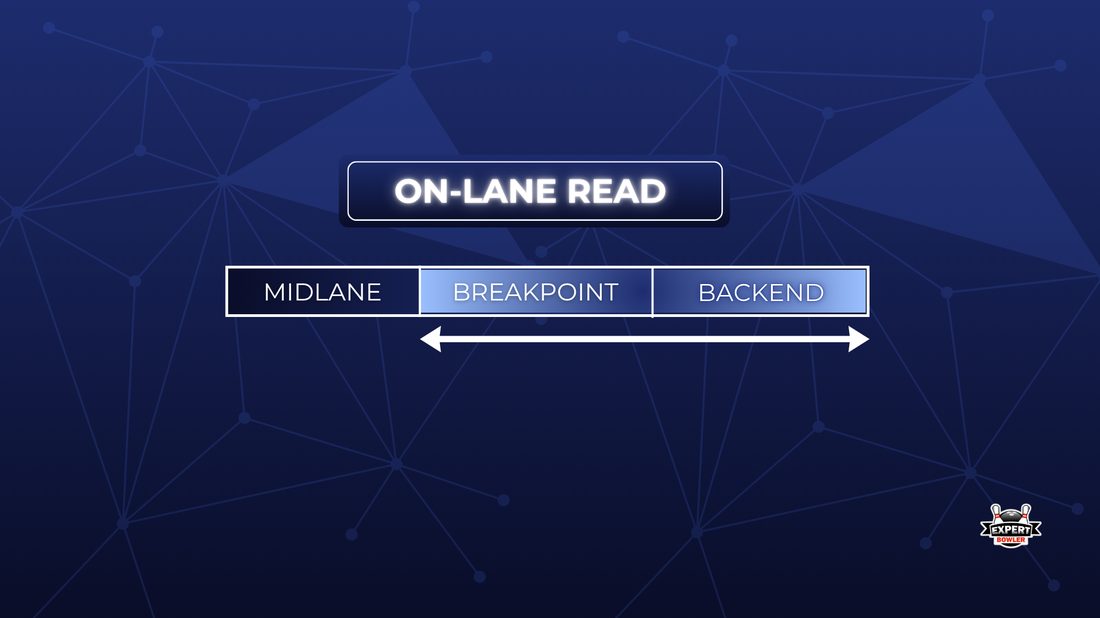
On a fresh, oilier house shot, the Spawn is built to do its best work in the mid to back part of the lane. The coarse solid should get it revving early, and the numbers suggest it clears the heads more cleanly than the surface implies — so rather than a hard, grabby read, expect a smooth, gathering arc that keeps going through the pins.
On paper that adds up to a strong, controlled roll with real continuation, which puts the Hammer Spawn hook potential comfortably above average — more a sweeping arc than a violent snap.
Who gets the most out of it comes down to hand and volume. Feed the Spawn oil and a decent rev rate and the design should pay you back with a strong, poured-on shape that stays reliable as the lane transitions. Hand it a dry or burned-up lane and it can grab too early and spend itself before the headpin, so drier players are better off with something tamer.
One mistake newer bowlers make is assuming a stronger ball automatically creates more hook. On dry house conditions the Spawn’s aggressive cover can burn up too early. If you notice it starting to roll forward and leave flat corners, that is usually your cue that the fronts have gone — move inside or switch to something cleaner rather than forcing it to keep striking. That is why this is not a great one-ball arsenal for most league bowlers.
If you bowl on medium-volume house shots most weeks, it is also worth checking our picks for the best bowling balls for medium oil lanes.
Answer four quick questions and our free Bowling Ball Finder matches you to the right ball for your style, lanes and budget — plus a free buyer’s checklist, instantly.
Take the free Finder →Best For and Who Should Skip It
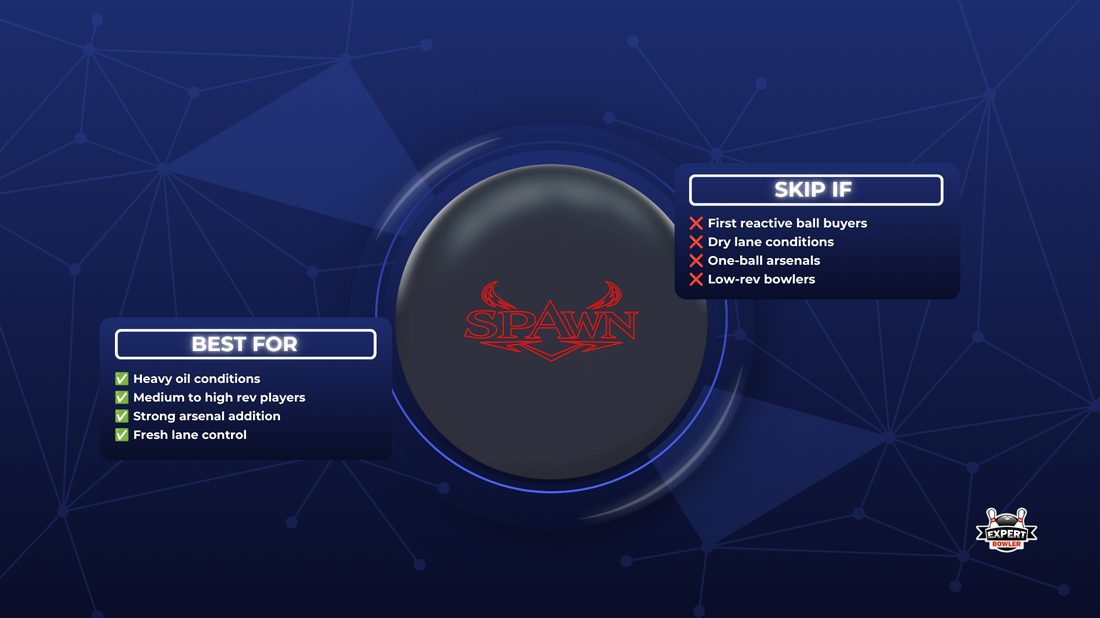
This is an arsenal piece, not a starter, and it is built for a fairly specific player. See where you land.
Buy it if this sounds like your game:
- You already carry a benchmark and want a dedicated strong ball for fresh, oily nights.
- Your rev rate and hand can turn a strong asymmetric over instead of shoving it through the front.
- Your league or your tournaments actually lay down volume, not a short, dry pattern.
- You would rather stay with one aggressive ball deep into transition than swap every game or two.
Skip it if any of these fit:
- You are buying your first reactive and still building a repeatable release.
- Your house runs dry or burns off fast.
- You want one ball to answer every shot.
Softer-rev players are not locked out, since surface and layout can calm the Spawn down, but the higher-rev and speed crowd will pull more out of it.
Wondering whether this belongs in your league bag? Our guide to the best bowling balls for league bowlers explains how to build a balanced arsenal.
Surface, Lane Conditions, and a Starting Layout
With a cover this strong, surface is where most of your tuning lives. As the fronts dry and the ball starts checking up too soon, a coat of polish or a higher grit pushes the read downlane and rounds it off. When the lane floods, fresh sanding brings the teeth back. Because the Spawn responds noticeably to surface changes, make one adjustment at a time and throw a few shots before deciding whether it needs more.
Layout deserves a real conversation with your driller, because an asymmetric like the Gauntlet hands them a mass bias to work with. The Hammer Spawn layout can be pinned to send the breakpoint later and smoother or earlier and sharper, so bring your rev rate, ball speed and axis point and let those set the pin and mass bias.
Since every house lays oil a little differently, it pays to read what is in front of you before you trust last week’s line. If you are never quite sure what the lane is telling you, our guide on how to read bowling lane conditions walks through the signs to watch for before you make adjustments.
Hammer Spawn vs Black Widow 3.0
Anyone shopping for a strong Hammer solid tends to hold it up against the Black Widow 3.0, which makes it the cleanest yardstick for the Spawn.
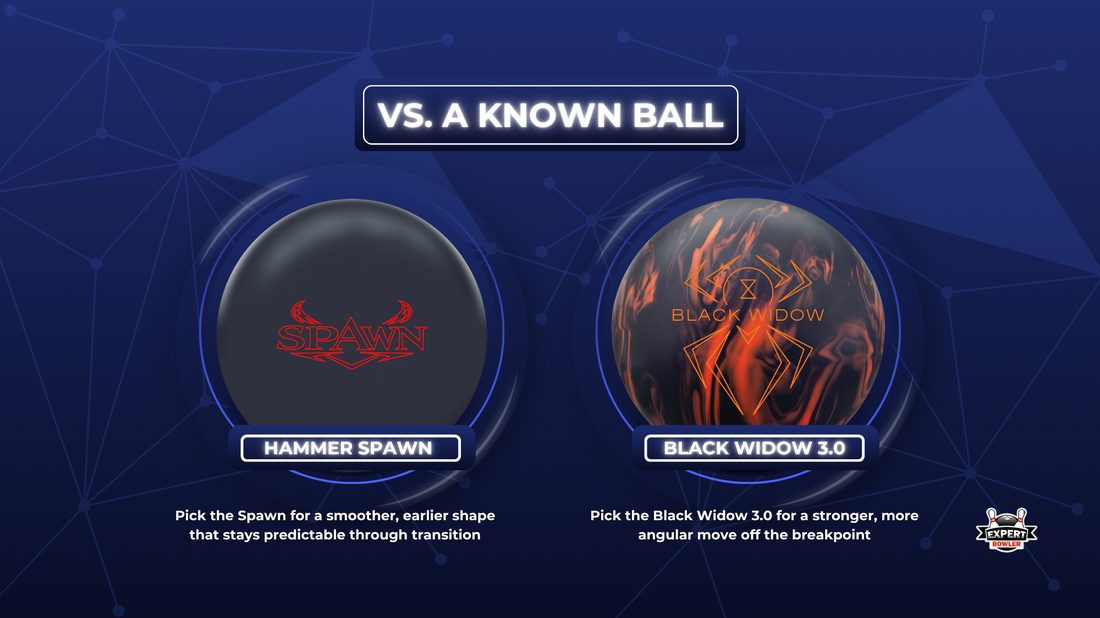
On paper these two live in the same neighborhood, and their RG sits a thousandth apart, so both get into an early roll. The daylight shows up at the core. The Black Widow 3.0 carries more differential and more mass bias, which buys it a bigger, more angular move off its spot. The Spawn trades some of that flare for a smoother, more repeatable shape, and because its box surface skips the 2000 step the 3.0 gets, it reads a touch earlier and smoother up the lane. One leans sharp and defined, the other leans strong and controllable.
So the call comes down to the shape you trust under pressure. If you prefer a smoother, earlier shape that stays predictable as the lanes transition, choose the Spawn. If you would rather see a stronger move off the breakpoint, the Black Widow 3.0 is still the better fit. We break down its full case in our Hammer Black Widow 3.0 review.
One thing not to mix up: the Spawn’s closest catalog neighbor is the Black Widow 3.0 Dynasty, a separate, newer ball, so do not treat the plain 3.0 and the Dynasty as the same piece.
Pros and Cons
Pros
- Asymmetric Gauntlet core plus the HK22C² Solid cover is built for a strong, defined shape on medium to heavy oil
- Designed to clear the fronts cleaner than most 500/1000 solids, holding energy for a controllable gathering arc instead of grabbing early
- Reads the midlane and backend smoothly rather than jerking off the spot, which should make it easier to repeat under pressure
- Mild .012 intermediate differential keeps the breakpoint smooth while the strong .050 differential still supplies the flare
Cons
- The 500/1000 box surface wants oil to work against, so it gives up traction fast once the lanes burn up
- Overlaps heavily with the Zero Mercy Solid on cover, so owners of that ball may not see enough separation to justify the buy
- Too aggressive at box for many house shots without enough volume to support it
- An arsenal piece — not a first ball or a one-ball answer
Is the Hammer Spawn Worth It?
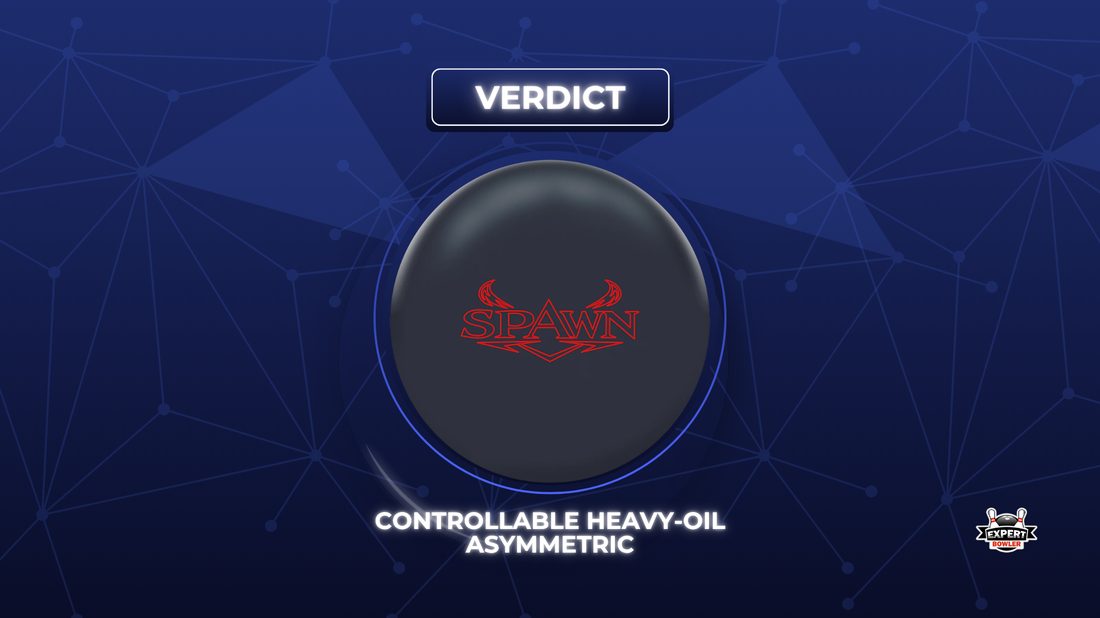
Buy it if you want a controllable heavy-oil asymmetric — a strong midlane read with a smooth, predictable move that stays usable as the pattern transitions — and you already have the rest of the bag handled. Skip it if your house is usually dry, this would be your first reactive, or you are expecting a dramatic upgrade over every strong Hammer solid you already own.
Underneath the launch buzz, the Spawn is a simple idea done well: a proven oil cover on a strong, controllable core for the bowler who has the rest of the bag handled. It never set out to be a dry-lane ball, and it does not pretend otherwise.
For bowlers who regularly see medium-heavy to heavy oil, it is an easy recommendation. If you would rather size up the whole 2026 field first, our best bowling balls hub puts the current picks side by side.
Frequently Asked Questions
Do the lighter Spawns roll like the 15-pound?
Not quite. The 15-pound lists a 2.501 RG and a .050 differential. The 16-pound moves up to a 2.512 RG with the differential easing to .044, while the 12 and 13-pound balls shift to roughly a 2.59 RG and a .041 differential — a longer, lower-flaring core.
Where does the Spawn sit next to the Zero Mercy Solid?
They share the same HK22C² Solid cover, so the difference comes down to core and surface. On the numbers the Spawn should read a touch quicker in response and a bit more angular and continuous off the spot, while the Zero Mercy Solid projects as the bigger, earlier oil ball.
Is the Spawn a smart first high-performance ball?
Usually not. It is a strong, oil-hungry asymmetric that wants revs, speed and volume to look its best. Most newer bowlers do better starting with a benchmark hybrid or a control solid, then adding a strong asymmetric like this once the release repeats and the bag actually needs a dedicated oil ball.
Does the box surface work for house shots, or only sport?
The 500/1000 finish is aimed at sport and heavier house patterns, where that rough surface has oil to chew on. On a lighter or worn house shot it can wake up too early and leave little for the back end, which is why plenty of owners polish it or take it to a higher grit for those nights.
Related guides
- Hammer Black Widow 3.0 review — the stronger, more angular benchmark it is measured against
- Best bowling ball brands — what Hammer is known for versus the rest of the field
- How to resurface a bowling ball — grit ranges and when a surface change beats buying new
- Best bowling balls buying guide — where this ball sits among the 2026 picks by bowler type
Sources & references
- Manufacturer specifications: Hammer official product and spec data for the Spawn
- USBC equipment specifications: approved ball list and RG minimum for league and tournament-grade equipment
- Comparison ball data: Hammer Black Widow 3.0, Zero Mercy Solid, and Black Widow 3.0 Dynasty official specifications
- Bowling ball technology references: coverstock, core, RG, differential, and intermediate differential fundamentals
Not sure the Spawn is your match? Take the free 60-second Ball Finder — it picks the right ball for your lanes, rev rate and budget, and sends you the buyer's checklist that stops you buying the wrong one.
Get our honest 2-page checklist — coverstock, weight, lane oil, and the 5 mistakes that cost most bowlers money. One short email every couple of weeks. No spam.

Edited by Jeroen Kooij
Editor · ExpertBowler
Editor of ExpertBowler. Responsible for editorial standards and methodology compliance. Read more about our editorial process.
Methodology: A specs-and-comparison analysis — evaluated against manufacturer specifications, the USBC approved-ball list, a benchmark comparison with the Black Widow 3.0, and verified owner input where it exists. We do not accept paid placements.
Updated: July 2026.