
Bowling Ball Surface Guide: Grit Chart 500-4000 + When to Use Each
By Jeroen Kooij, Publisher & Editorial Director · Beginner Bowler · Updated August 2026
When a familiar ball reaction changes, lane transition and coverstock surface are two important variables to check. They are not the only possibilities — release changes, ball fit, oil volume, and the ball itself can all affect what you see.
With use, the visible texture of a reactive cover can change and lane oil can accumulate on or within the coverstock. That can alter how the ball responds to friction compared with its fresh or recently maintained condition.
Before assuming you need a different ball, check cleaning, surface condition, lane transition, and your own execution. A controlled surface adjustment can change reaction meaningfully, but it should be treated as one diagnostic tool rather than an automatic fix.
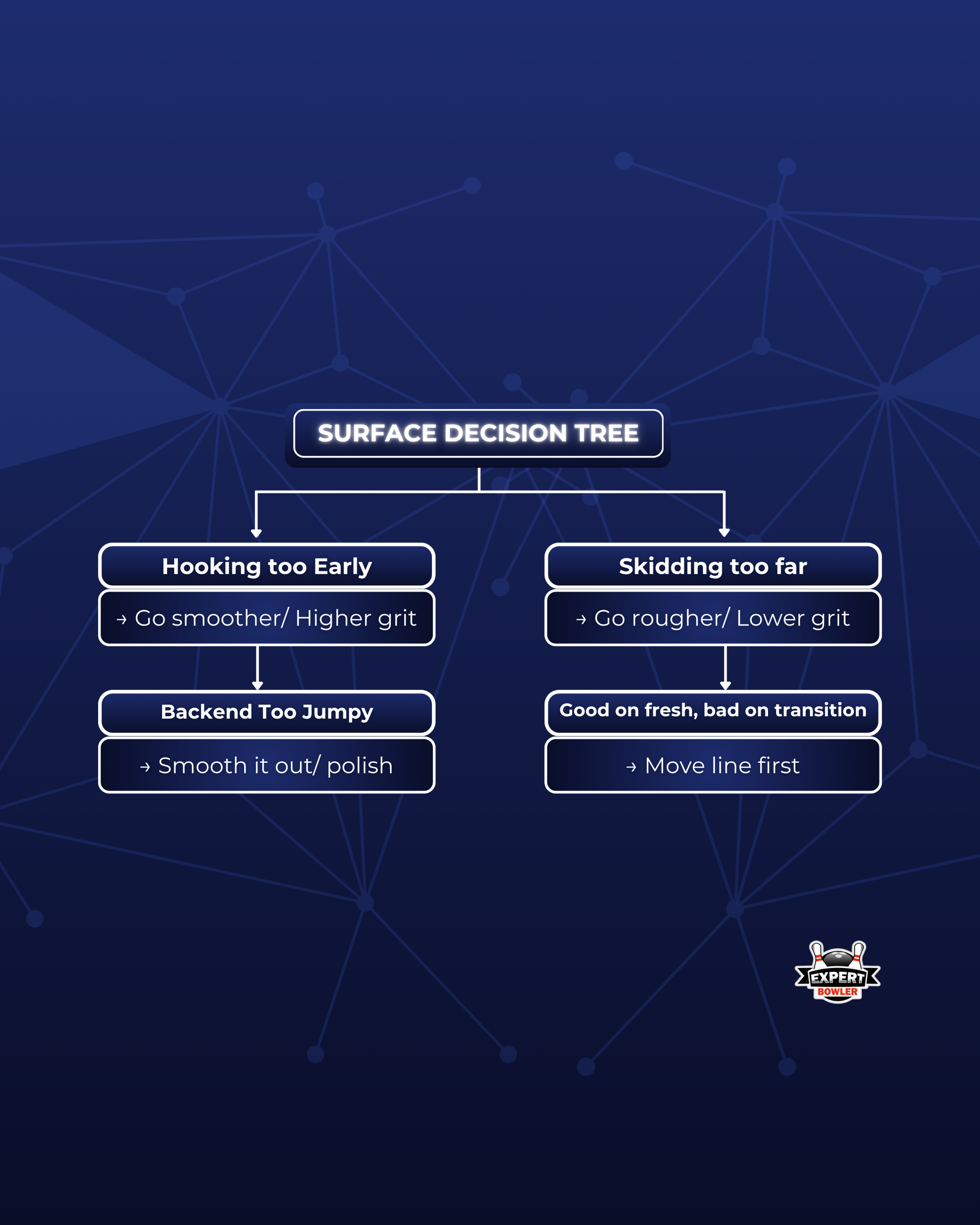
If you are not sure whether the problem is surface or pattern, the decision tree in the middle of this guide is the fastest way to find out.
What we cover in this guide
- What Is Bowling Ball Surface?
- Why Surface Changes Reaction Faster Than Most Bowlers Expect
- Grit Chart 500-4000 (What Each Range Does)
- How Your Release Profile Affects Grit Choice
- Surface Decision Tree
- How to Resurface a Bowling Ball at Home (Step-by-Step)
- Fresh to Transition: When to Change Surface vs Line
- Common Surface Mistakes and Fixes
- Maintenance Schedule: Clean, De-oil, Re-surface
- Frequently Asked Questions
- How to Resurface a Bowling Ball: Putting It Into Practice
What Is Bowling Ball Surface?
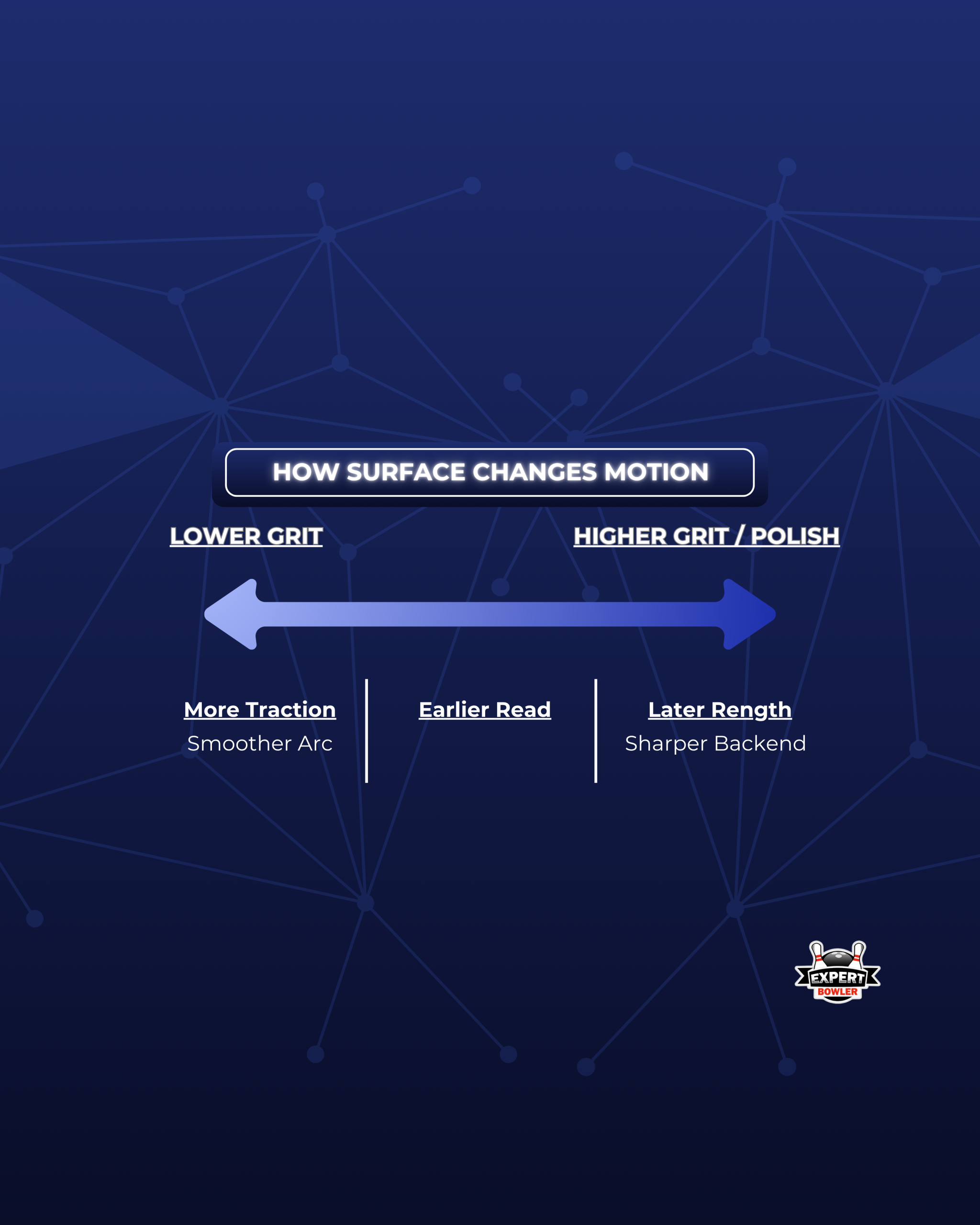
Bowling-ball surface describes the texture and finish of the coverstock, commonly expressed through abrasive grit and/or polish. Lower-grit finishes generally create more surface texture and can help a ball see friction sooner; smoother finishes generally promote more length. The actual reaction still depends on cover chemistry, core, drilling, release, and lane condition.
Why Surface Changes Reaction Faster Than Most Bowlers Expect
The coverstock is the ball’s contact surface with the lane. Changing its texture changes how the ball interacts with oil and friction, but grit alone does not predict ball motion.
Cover type and chemistry matter alongside grit. Two balls finished at the same nominal grit can still react differently because solid, pearl, and hybrid labels do not describe identical chemistry or construction across manufacturers.
Core design, RG, differential, layout, coverstock chemistry, and surface all contribute to ball motion. Surface is one of the easier variables to adjust after drilling, which makes it useful to test before assuming the ball itself is wrong for the condition.
Answer four quick questions and our free Bowling Ball Finder matches you to the right ball for your style, lanes and budget — plus a free buyer’s checklist, instantly.
Take the free Finder →Grit Chart 500-4000 (What Each Range Does)
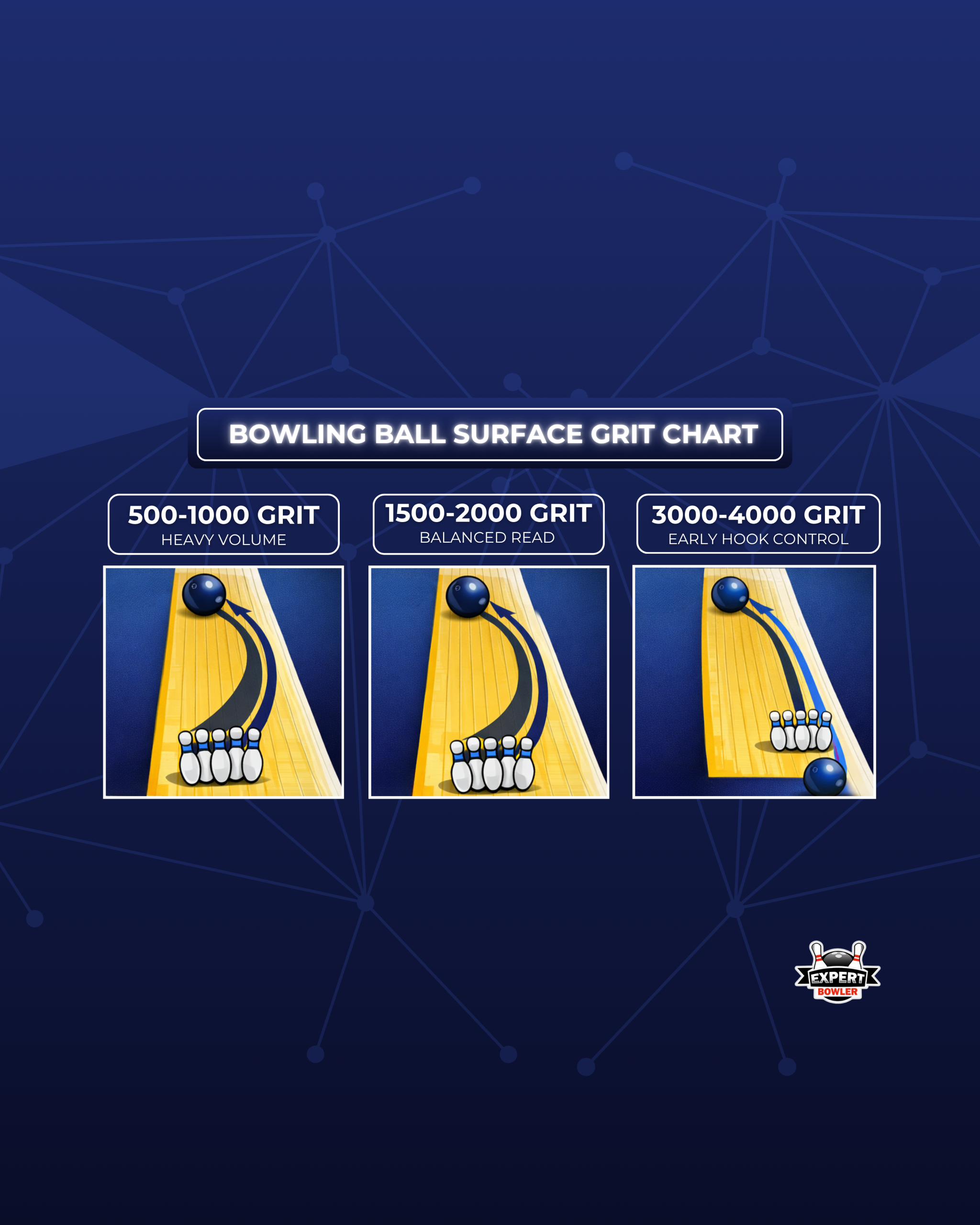
Use the table as a reference point, then read the breakdowns below for details.
500-1000 Grit
Coarser finishes such as 500–1000 grit increase surface texture and often make a reactive ball read the lane sooner. They are commonly explored when a bowler needs more traction or a smoother overall response, but the same grit can look very different on different covers and releases.
1500-2000 Grit
The 1500–2000 range is a useful middle reference between very coarse surfaces and highly smoothed or polished finishes. It can produce a balanced look on many combinations, but it is not automatically the best range for a house shot or for every release.
Factory finishes can differ by exact model and release. If you are trying to restore a ball such as the Storm Hy-Road to box condition, use the manufacturer specification for that exact version rather than assuming one universal grit sequence.
3000-4000 Grit and Polish
Smoother finishes such as 3000–4000 grit, and polished finishes where appropriate, generally reduce early surface traction compared with coarse sanding. That can create more length, but it does not guarantee a sharper backend; downlane shape depends on the rest of the ball and the lane.
A smoother surface can be one option when a ball is reading the front part of the lane too early. Sometimes a line change or a weaker ball is the better answer, so test one variable at a time rather than assuming polish is the transition fix.
For a product-level example of a smoother benchmark shape, see our Motiv Venom Shock review. The comparison is illustrative; we are not claiming first-hand lane testing here.
Best Bowling Balls 2026
Looking for our top equipment picks? Start with the full ball roundup.
How Your Release Profile Affects Grit Choice
Release profile changes how a surface choice looks. A speed-dominant player may need more help creating traction; a rev-dominant player may see a coarse surface read too early. Those are tendencies, not fixed grit prescriptions.
Use ball speed, rev rate, axis rotation, and the actual shape on lane as context. The goal is not to classify yourself into a grit number; it is to identify whether the ball needs to read earlier, later, or more smoothly.
Surface Decision Tree
Already know what grit you need? Skip to the step-by-step. Still figuring out what the ball is doing? Work through these in order.
Change one thing at a time. Once you make a change, use the four-point check at the end of the step-by-step before touching anything else.
- The ball seems right on fresh, but changes too much on transition: First confirm that the lane, not your release, is the changing variable. A line change, weaker ball, or smoother surface may each be valid options. Understanding bowling oil patterns helps you interpret that transition.
- The ball is reading too early on a known fresh condition: Consider a modest move toward a smoother finish, but document the starting surface and make one small change at a time. Do not assume a specific grit jump is correct without testing.
- The ball is skidding too far or not reading soon enough: A modestly rougher finish may help create earlier traction. Test that change against a consistent line before deciding the ball itself is wrong for the pattern.
- The backend response feels too abrupt: A smoother surface may change where the ball sees friction, but it can also change response to dry in ways that depend on the ball. Test surface, line, and ball choice separately rather than treating higher grit as a guaranteed backend fix.
- Multiple issues at once: Identify the most repeatable symptom and isolate one variable. On changing lanes, line, speed, or ball choice may be more useful to test before permanently altering surface.
How to Resurface a Bowling Ball at Home (Step-by-Step)
If you have not identified the surface change you need yet, go back to the decision tree first. This section is about execution, not diagnosis.
What you need
Bowling-specific abrasive pads in the grit range you intend to use, water where the abrasive system calls for wet sanding, a stable way to hold or rotate the ball, bowling-safe cleaner, and a clean towel. A ball spinner makes uniform work easier but can also remove material quickly, so follow product and manufacturer guidance.
Use abrasives and compounds intended for bowling-ball surface work, and compare abrasive systems carefully: nominal grit numbers do not always produce identical finishes across brands, pad age, or pressure.
We put together a rundown of the best bowling ball sanding pads if you need to compare before buying.
How to Do It
- Clean and inspect first. Clean the ball and confirm the reaction problem is repeatable. If cleaning restores the reaction, sanding may not be necessary. If embedded oil or a major restoration is suspected, consider a qualified pro shop before combining several maintenance procedures.
- Secure the ball and follow the abrasive system. Hold the ball securely or use a spinner if you know how to operate one safely. If the abrasive system calls for wet sanding, keep the pad appropriately lubricated and work evenly over the whole ball.
- Apply the target abrasive evenly. Work over the entire permitted ball surface using consistent pressure and a repeatable sequence. Do not rely on a universal number of seconds or rotations; pad condition, spinner speed, pressure, and starting surface all change the result.
- Use progressive grits only when the target recipe calls for them. The exact progression depends on the finish you are trying to reproduce; there is no universal requirement to finish one grit step finer.
- Polish only if the target finish uses polish. Use a bowling-ball polishing compound according to its instructions and apply it evenly. Avoid chasing a universal buffing time or deliberately building heat as a performance technique.
- Final clean. Remove residue with a bowling-safe cleaner that is legal for the type of competition you bowl. Let the ball dry fully before evaluating the finish.
- Test against a known baseline. Evaluate enough shots to distinguish a real reaction change from one poor release or a changing pair of lanes. Keep notes before making another adjustment.
A see-saw, shammy, or clean towel can help remove visible lane oil from the cover. If you are comparing maintenance accessories, see our bowling-ball accessory reviews.
Cleaner choice should be based on the coverstock, product instructions, and current competition rules. Our bowling ball cleaner guide compares the main options without treating approval status as a performance guarantee.
Once you have made the change, go back to the same signal that identified the problem. If front-lane read was the issue, check whether it has normalized across fresh oil and later frames. One signal, confirmed or not, tells you whether to hold the surface or adjust again.
Fresh to Transition: When to Change Surface vs Line
Surface, line, speed, and ball choice can all change reaction, and there is no universal sequence that works on every pattern. A useful principle is to avoid making a permanent surface change simply to chase a lane that is actively transitioning.
- On a known fresh condition: surface is easier to evaluate because you have a cleaner baseline. That does not make it the automatic first adjustment.
- During transition: reversible adjustments such as line, speed, or ball choice are often easier to evaluate than permanently changing the cover while the lane itself is moving.
Example 1: Ball Reading Too Early on a Known Fresh Condition
Suppose a familiar ball begins reading earlier than expected on a condition you know well. Before sanding, confirm that release, lane pair, and ball cleanliness are not the more likely explanation.
If surface drift is the likely variable, a controlled move toward a smoother finish is one experiment. The point is to isolate the variable — not to assume polish or one specific grit is always the diagnosis.
After the change, compare the ball against the same baseline and record whether it reads earlier, later, or simply differently. If the reaction does not improve, restore the known surface or involve a pro shop rather than continuing to sand.
Example 2: Reaction Changes as the Lane Transitions
Suppose the ball looks useful early but begins reading too soon as the set progresses. That may be lane transition rather than a surface problem.
First test a reversible adjustment — line, speed, or a different ball — before changing the cover for a condition that may exist only late in the set.
If the same reaction problem appears repeatedly on the same fresh-to-transition sequence, a smoother surface may be worth testing between sessions. Treat that as an experiment, not a guaranteed cure.
Consistent maintenance helps you distinguish surface drift from lane transition. See our bowling ball cleaning and maintenance guide for the broader routine.
Scenario 3: Nothing Works
Sometimes surface changes do not create the motion you need. That can mean the ball, layout, release match, or lane condition is the larger constraint. Do not keep removing coverstock material simply because the first surface experiment did not work.
Our guide to the best medium oil bowling balls is a good place to start on house shots, and if the outside boards are drying out early, our best bowling balls for medium to dry lanes cover the right options for that.
Common Surface Mistakes and Fixes
The mistakes below are process errors to avoid when experimenting with ball surface. They are not a substitute for the manufacturer’s recommended surface recipe or for having a pro shop restore a ball accurately.
Changing the surface and ball position at the same time. If you adjust the surface and move your feet in the same session, you have no way of knowing which change produced the result. Isolate one variable. Surface first on fresh oil, then line if the surface change was not enough.
Uneven pressure can create an uneven finish. Keep the abrasive flat and work consistently over the whole ball; if you cannot reproduce an even finish by hand, use a qualified pro shop.
Skipping steps can produce a different finish from the recipe you intended. If your goal is to restore a factory surface, follow the manufacturer’s current surface sequence for that exact model rather than inventing a generic progression.
Every abrasive adjustment removes some coverstock material. Avoid sanding simply because a fixed number of games has passed; clean the ball, identify a repeatable reaction change, and use the least aggressive adjustment that solves the actual problem.
Different abrasive systems can cut differently even when the printed grit number looks similar. For repeatability, use a known bowling-surface system and document the exact pads and sequence you used.
Do not use a kitchen oven or uncontrolled heat source to extract oil. Follow the ball manufacturer’s care guidance or use a pro shop/purpose-built rejuvenation process. See our bowling ball rejuvenator guide for the equipment category.
Maintenance Signals: Clean, De-oil, Re-surface
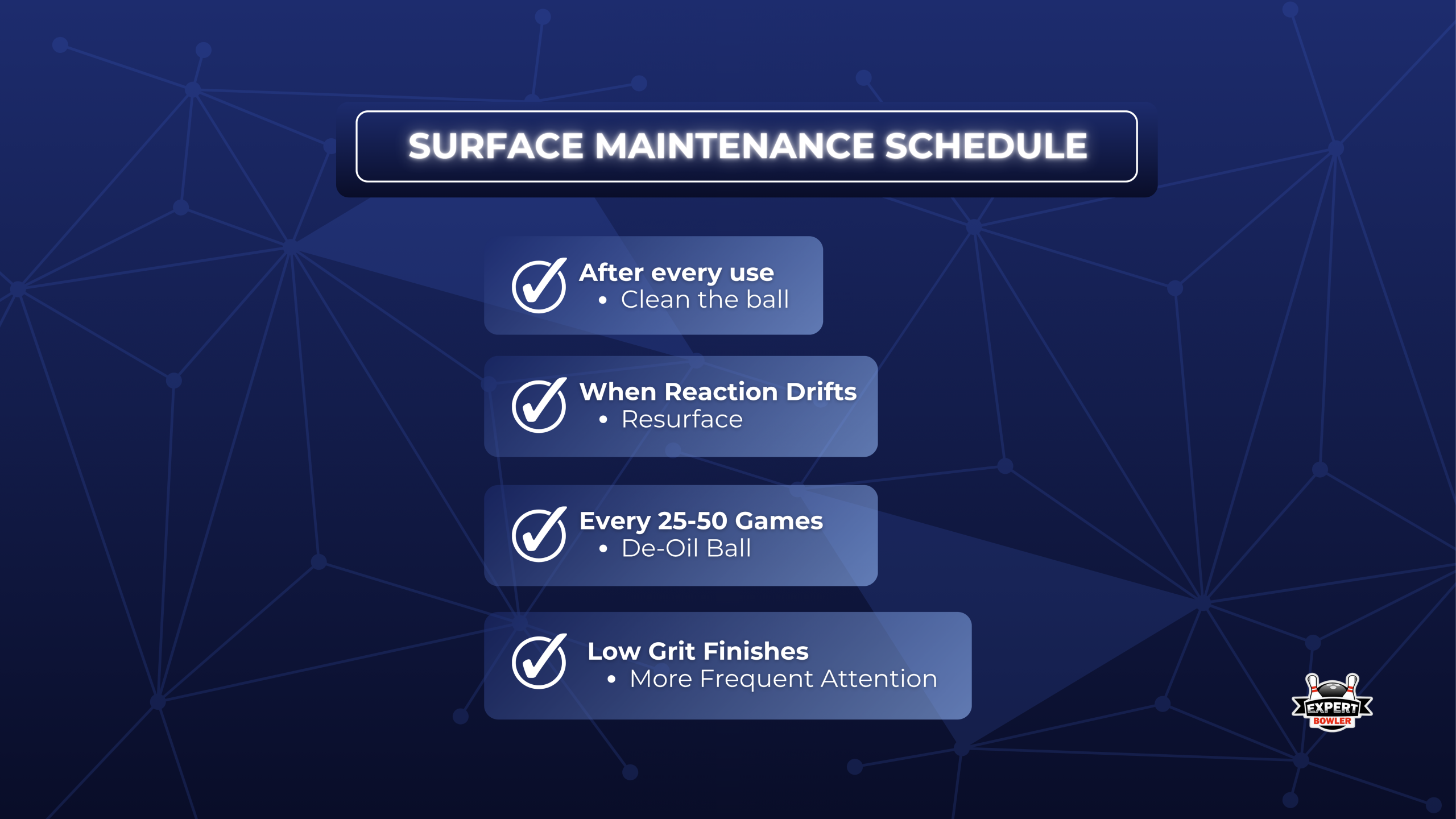
Maintenance should be driven by observed condition and reaction rather than one universal game-count schedule. Cleaning, oil extraction, and resurfacing solve different problems.
Use the signals below as a diagnostic order. Manufacturer guidance and your pro shop should take priority when a ball needs a full restoration.
Routine Cleaning
After bowling, remove visible lane oil and use a bowling-safe cleaner according to its directions and the rules that apply to your competition. Routine cleaning helps keep surface contamination from becoming another variable when you evaluate reaction.
When Routine Cleaning Is No Longer Enough
Reactive covers can retain oil over time, but the point at which deeper cleaning or oil extraction is useful varies by ball, coverstock, lane environment, and maintenance habits. If reaction changes and normal cleaning does not restore it, inspect the surface and discuss rejuvenation with a pro shop before assuming a fixed game count.
Frequent use can accelerate surface and oil-related changes, but frequency alone does not tell you when a rejuvenation procedure is necessary.
Resurfacing Schedule
All finishes evolve with lane contact. Coarser surfaces can lane-shine quickly, while polished finishes can also lose their original character. The useful question is whether the ball still matches the reaction you expect after normal cleaning.
If the reaction has changed in a repeatable way despite normal cleaning, compare the current surface with the manufacturer’s intended finish and decide whether a light surface refresh or professional restoration is appropriate.
Inspect the ball regularly for visible damage, uneven surface, contamination, or a track area that looks noticeably different from the rest of the cover. Appearance alone does not prove the surface needs sanding.
Frequently Asked Questions
How often should I resurface a bowling ball?
Go by repeatable reaction change and the condition of the surface, not a fixed calendar or game count. Clean first; if the ball still no longer matches its intended reaction, compare the current surface with the manufacturer specification or have a pro shop inspect it.
Can I resurface a bowling ball at home?
Yes, light surface adjustments can be done at home if you understand the abrasive system and can work evenly. For a full factory restoration, damage repair, or any procedure you are unsure about, a pro shop is the safer route.
What grit should I use on my bowling ball?
As a broad starting point, coarser grits tend to create earlier traction and smoother response, while smoother grits tend to create more length. Do not select grit from a chart alone; coverstock, release, lane condition, and the manufacturer’s intended finish all matter.
How many times can a bowling ball be resurfaced?
Abrasive work removes coverstock material, so there is no useful universal number of resurfaces a ball can safely take. The amount removed depends on method, damage, starting condition, and how aggressive each restoration is. Avoid unnecessary sanding and use a pro shop for major restoration.
What is the difference between resurfacing and polishing?
Resurfacing changes or restores the cover’s texture with abrasives. Polishing uses a finishing compound or process to create a smoother surface. The exact sequence depends on the desired finish and product system; polishing is not always required after sanding.
Does my ball need resurfacing or just cleaning?
Start with cleaning because it is the least invasive variable. If the ball still reacts differently, compare the current surface with the intended finish and consider lane transition, release, and oil saturation before deciding to resurface.
How to Resurface a Bowling Ball: Putting It Into Practice
Surface experiments are most useful when you can trace cause and effect. Change one variable, test it against a known baseline, and document what happened. Do not assume every reaction problem is a surface problem.
When the surface is not the answer and a new ball is, our guide to the best bowling balls for league bowlers covers the right options by condition and skill level.
Quick-Reference Checklist
- Pin down one specific reaction problem before touching the ball. Too early, too late, too jumpy. Pick one.
- Change the surface one step at a time and go back to fresh oil before deciding if it worked.
- Work evenly across the full surface using the abrasive system’s recommended technique. If you cannot reproduce an even finish, use a pro shop.
- Test on fresh oil and in later frames after each change before making another adjustment.
- Log leave patterns and carry after each surface change to track what worked.
- Use routine bowling-safe cleaning to keep contamination from becoming another reaction variable.
- Consider deeper cleaning or rejuvenation when normal cleaning no longer restores the expected reaction; do not use a fixed game-count rule.
Related guides
- Best bowling balls 2026 — researched picks across skill levels
- How to read bowling lane conditions — the foundation of ball selection
- Best bowling shoes 2026 — slide consistency starts with your shoes
- Bowling spare shooting guide — pick up the 7-pin, 10-pin, and tricky splits
- Bowling ball cleaning & maintenance — protect your investment
Get our honest 2-page checklist — coverstock, weight, lane oil, and the 5 mistakes that cost most bowlers money. One short email every couple of weeks. No spam.

Edited by Jeroen Kooij
Publisher & Editorial Director · Beginner Bowler
Jeroen sets ExpertBowler’s editorial standards. This guide is research-based and does not claim that Jeroen is a bowling-ball technician or that every surface recipe has been personally tested. Technical points should be checked against current manufacturer and competition guidance. Read how we research and update our content.
Editorial standards: Surface guidance is cross-checked against manufacturer documentation, current equipment/rule references, and published technical instruction. Exact maintenance intervals are not presented as universal rules. We do not accept paid placements.
Updated: 2026.
Sources & references
- Manufacturer documentation: current factory-finish, coverstock, care, and surface information should take priority for the exact ball being serviced
- USBC/Bowl.com: current equipment and competition references where surface preparation or product legality is relevant
- Published technical instruction: established bowling maintenance and ball-motion resources used to cross-check general surface principles
- Community & owner context: used to identify recurring maintenance experiences, not to establish universal grit or game-count rules

Ok…my mental gears are turning. I am generally rolling a Hammer Black Widow 3.0 and a Black Widow 2.0 Hybrid during league play, “normal house shot”. After working a long time on my form and staying behind the ball, my revs and roll effectiveness have gone up seemingly a good amount. Both balls are now too aggressive through the night. Can “should” I resurface both, but increase “box” surface by 500? I.e. BW 3.0 is box at 500-1000-2000. I am thinking move to 1000-1500-3000. BW2.0H is 500-1000-1500-Polish…thought is 1000-1500-2500-Polish. Thoughts? THANKS
Great question, and the instinct is right — when your revs go up, your old surface starts reading the lane earlier than it used to, and both of those balls are already aggressive pieces to begin with. Bumping every grit step by ~500 will move you in the right direction, but I’d push back a little on the strategy.
The dominant factor in surface reaction is the final grit (and whether or not there’s polish on top of it). The intermediate steps mostly just get you to a clean, even finish before the last pad. So instead of resurfacing both balls in one go, I’d test the biggest lever first.
For the BW 3.0, going from box 2000 to a 3000 or even 4000 finish will give you a noticeable amount of length without changing the ball’s character. A lot of higher-rev players run the 3.0 at 4000 on medium house and it shapes up beautifully — earlier length, smoother midlane read, but still that HK22 backend pop. That’s a bigger change than the 500-grit bump and probably solves your “too aggressive through the night” problem on its own.
For the BW 2.0 Hybrid, your plan (1000-1500-2500-Polish) is reasonable, but honestly the polish is doing most of the work on that ball already. If it’s only overreacting late in the night, a fresh re-polish over the current surface might be all it needs — no full resurface required. Polish wears off faster than people realize, especially with higher revs.
Two more things worth flagging:
Change one ball at a time, bowl three sessions, then decide on the other. If you swap both at once and the look changes, you won’t know which adjustment did what.
If both balls feel like too much all night, the gap in your bag is probably a weaker piece for transition — a benchmark symmetric or a pearl — rather than a surface adjustment on what you already own. Surface tweaks buy you a few games; the right third ball solves it.
Hope that helps — let us know how it shapes up.
— Jeroen